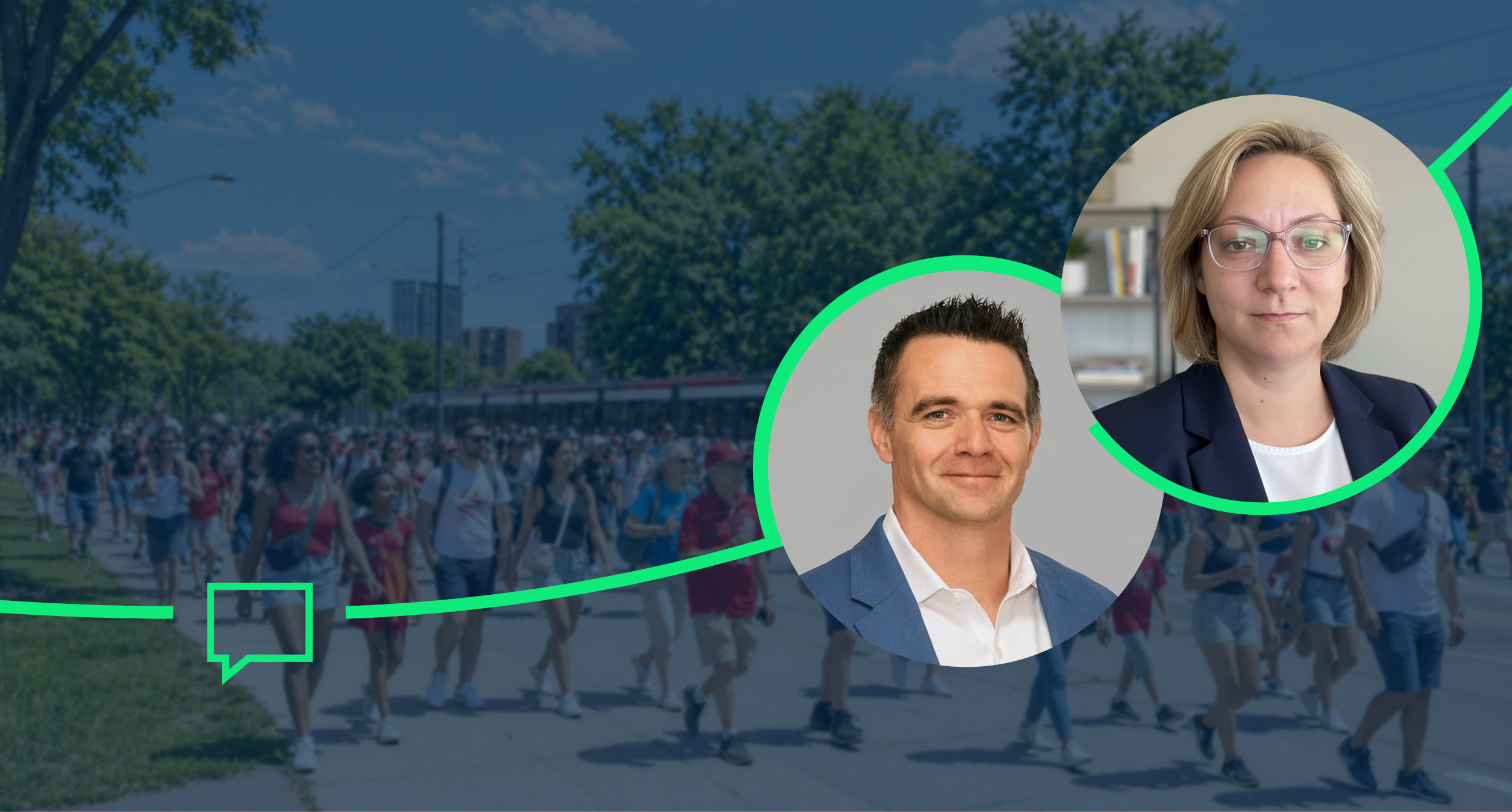
From the World Cup in Canada, the United States, and Mexico to the Canada Day celebrations and the 250th anniversary of American independence, North America has hosted a series of major public events in recent times that have brought millions of people together.
When cities welcome large crowds, mobility becomes essential to keeping people moving efficiently and the overall experience running smoothly. We spoke with Leah Beleck, Managing Director of Scheidt & Bachmann Canada, and Daniel Terryn, Managing Director of Scheidt & Bachmann USA, about why transit plays such a critical role during large events — and what that means in practice for fare collection, station access and the long-term passenger experience.
Leah, Daniel, when cities prepare for events of this scale, why does public transit matter so much?
Leah: Because without transit, events of that scale simply don’t work. Cities can prepare venues, security concepts and visitor programs, but if large numbers of people cannot move efficiently through the city, the pressure builds very quickly. Public transit is what helps a city remain accessible and functional during periods of extraordinary demand. And in the best cases, the improvements made for an event continue to benefit passengers long after the event itself is over.
Daniel: I would add that these events put mobility systems under a very public spotlight. People may not think much about transit when everything works, but the moment access becomes slow, confusing or overcrowded, it affects the entire experience. That is why transport authorities and operators have to think beyond capacity alone. They also must think about simplicity, reliability and flow.
These events are very different in character. From a transit perspective, where do the biggest common challenges lie?
Daniel: The biggest common factor is concentrated demand. You have short windows in which very large numbers of people need to move at the same time — before and after a match, after fireworks, or around a parade route. And many of those passengers are not regular riders. They may be visitors, tourists or occasional users who are unfamiliar with the local network and fare structure.
Leah: Exactly. That combination is what makes things interesting. It is not only about moving more people, but about making the system easy to understand for people who may be using it for the first time. If the first interaction with transit feels complicated, whether that is finding the right ticket or understanding how to pay, you create friction right at the start of the journey.
For visitors and occasional riders, that first interaction is crucial. What helps make transit feel intuitive right away?
Leah: In many cases, it starts with reducing barriers at the point of entry. Fare collection is often the first real touchpoint a passenger has with a system, so it needs to feel clear and straightforward. That is where open payment can make a real difference. If passengers can simply tap their own contactless bank card or mobile wallet, they can access transit immediately without first having to navigate an unfamiliar tariff model or queue at a vending machine.
Daniel: And that simplicity matters under pressure. During major events, people are often making quick decisions. They want to get to a venue or back to their hotel without having to stop and decode a ticketing system. The easier it is to access the network, the more likely public transit is to be used confidently and at scale.
Open payment is getting a lot of attention. But in reality, how far does it go?
Leah: It is an important part, but not the whole answer. No single access model works for every passenger. Some prefer to tap with a bank card or smartphone, while others rely on a transit card or conventional ticket purchase. That is why flexibility matters. A modern fare management approach must bring these channels together consistently. Account-Based Ticketing enables different media and access options to be managed centrally while giving agencies more flexibility to design and evolve their tariff structure.
Let’s move from payment to the station environment. In moments of peak demand, access points can become critical very quickly. What matters most there?
Daniel: Flow. In high-volume situations, every second counts. Stations must guide people forward intuitively, with clear visual guidance, visible fare gate availability and a setup that supports quick decisions.
At the same time, they have to meet different passenger needs, including people with luggage, families with children and those requiring wider access or additional guidance. That is why the technology must do more than simply control entry. It has to support throughput, accessibility and clarity at the same time. With solutions such as the FareGo PG|50 fare gate, the goal is not just to validate access, but to help stations manage high passenger volumes while still delivering a user-friendly and inclusive experience.
So, the real challenge is not just speed, but balancing speed with inclusion?
Leah: Absolutely. The system only works well if it works for different kinds of passengers. Speed matters, but not at the expense of usability. During large events, that becomes especially visible, because the passenger mix is so broad.
Daniel: And from an operator’s perspective, those things are closely linked. The clearer and more intuitive the system is, the better the flow tends to be. Good accessibility and good throughput are not competing goals. In many cases, they support each other.
When the event is over, what remains? What is the longer-term value for cities and operators?
Daniel: The event itself may be temporary, but the infrastructure and operational insights will remain. The only real change after the event is the volume of passengers. Once the crowds have dispersed, cities continue to benefit from the improvements made to accommodate them. Modernized payment options, clearer passenger guidance, more efficient station access, and greater operational flexibility continue to create value long after the event ends.
Leah: That’s the long-term opportunity. While ridership levels may return to normal, passenger expectations do not. People still want accessible, reliable, and easy-to-use transit. Investments made for major events can therefore improve the everyday travel experience, making public transit more intuitive and convenient for regular and occasional riders.
Finally, if you had to sum it up in one sentence: what do major events reveal about public transit?
Leah: They show that public transit is not simply there to support the event in the background — it is one of the things that makes the event possible in the first place.
Daniel: And they remind us that when mobility works well, people hardly notice it. But that is exactly the point.
Thank you, Leah and Daniel, for these valuable insights!
Want to learn more about solutions such as open payment, Account-based Ticketing and the FareGo PG|50 fare gate?
Explore how Scheidt & Bachmann supports operators in creating accessible, efficient and reliable transit experiences.